

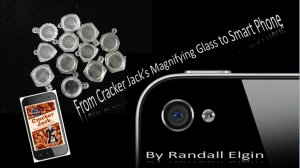
From Cracker Jack’s Magnifying Glass to SmartPhone
In recent decades the quality of plastic optics has improved drastically. What was formerly considered to be cheap, low-quality lenses are now high-quality, lightweight, low-cost, precision optics. These optics can be seen everywhere (though more likely you haven’t noticed them) in a wide variety of products.
Plastic optics weigh less than glass optics and are easier to handle during manufacturing. High refractive index plastics enable thinner and flatter designs, which in turn enable the thin and sleek shapes in today’s cell phones, tablets and laptops.
The OKP plastics are high purity, polyester polymers with refractive indices ranging from 1.61 to 1.65. These materials are always improving. Osaka Gas recently introduced a 1.64 refractive index material (Part Number OKP-1) with extremely low birefringence. Birefringence in polymers is predominately the result of the molding process.
Most polymer plastics are inherently isotropic (that is, that is they have no directionality in their optical properties). However, when formed in the injection molding process the polymer is melted, injected and cooled, which depending on the material can induce stress that shows up as birefringence in the finished molded part.
OKP-1 offers a 1.64 refractive index and very low birefringence. No doubt we will continue to see more and more plastic optics enabling new and ever more powerful applications.
This article is an original publication of Fiber Optic Center, Inc. It is shared publicly for educational and reference purposes to support learning and professional development within the fiber optics industry.
You are welcome to read, cite, or reference this material for non-commercial and educational purposes, as long as full credit is given to Fiber Optic Center, Inc. and the author.
Reuse, reproduction, or adaptation of this content — including rewriting, republishing, or incorporating it into new materials (such as websites, blogs, marketing text, technical guides, or AI-generated content) — is not permitted without prior written consent from Fiber Optic Center, Inc.
This material is protected by copyright law upon publication, even if not formally registered.
Use of this content for AI training, automated data extraction, or derivative content generation is prohibited.
Fiber Optic Center monitors and enforces the integrity of its intellectual property through digital identifiers and content tracking.
For more details, please refer to the Fiber Optic Center Content Use and Copyright policy.